Shaping Global Standards: QuoData Scientists Present New Statistical Sampling Concepts at the 45th CCMAS Session
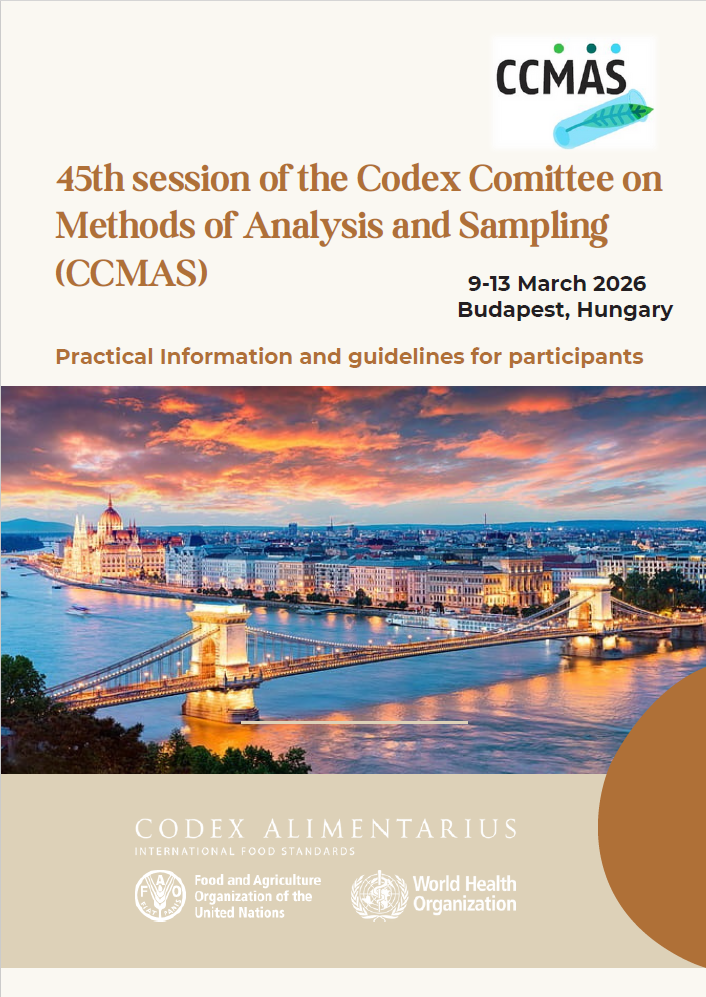
The global food safety and trade community gathers in Budapest for the 45th Session of the Codex Committee on Methods of Analysis and Sampling (CCMAS), taking place from March 9–13, 2026. QuoData’s statistical experts, Bertrand Colson and Steffen Uhlig, will be on-site to present and discuss groundbreaking new concepts for sampling bulk materials and heterogeneous lots.
Update: The contribution of QuoData scientists was well received. It was agreed to continue work on a draft for guidance on sampling plans for bulk materials / heterogeneous lots taking into account the discussions in CCMAS45 and any feedback from Codex Committee on Contaminants in Foods (CCCF). Presentations and contributions of the 45th Session of the Codex Committee on Methods of Analysis and Sampling are available for streaming. You can find the session with contribution from QuoData scientists on YouTube:
From the UN to the Laboratory: Why CCMAS Matters
The work done at CCMAS is not just about laboratories; it is about global diplomacy, economics, and human health. The committee is a crucial pillar of the Codex Alimentarius, a joint program established by two United Nations (UN) powerhouses: the Food and Agriculture Organization (FAO) and the World Health Organization (WHO).
The standards set here directly support the UN’s Agenda 2030, specifically Sustainable Development Goals like Zero Hunger (SDG 2) and Good Health and Well-being (SDG 3). Furthermore, these standards hold immense legal weight: The World Trade Organization (WTO) explicitly recognizes Codex guidelines as the ultimate international reference point for resolving global trade disputes.
CCMAS is where the "rules of the game" are written. It defines exactly how products must be tested and sampled to ensure that Codex standards are verifiable. With Germany—represented by the Federal Office of Consumer Protection and Food Safety (BVL) — holding the chair of CCMAS, QuoData is proud to contribute high-level German statistical expertise to this vital UN framework.
The Challenge with Heterogeneous Lots
Classical sampling plans were developed on the assumption that the lots are relatively homogeneous. However, for contaminants such as mycotoxins, contamination often appears in localized "hot spots." In such cases, special statistical methodes are required to estimate the risks associated with a given sampling plan.
To address this, QuoData scientists, as part of an international Expert Working Group led by New Zealand and co-chaired by Germany, have been instrumental in developing a new, data-driven framework. Moving away from more traditional models, the proposed approach leverages modern Bayesian and utility-based statistical frameworks. This allows for a more dynamic balance between risk and testing costs, using real-world data to calculate accurate sampling plans.
A Highlight on the Agenda
QuoData’s continuous commitment to advancing quality assurance statistics is reflected in the official CCMAS 45 agenda. On Wednesday, March 11, Bertrand Colson, Steffen Uhlig, and fellow contributors will host two dedicated sessions on this topic:
- 14:00 – 15:30: An informal, interactive workshop on sampling plans for bulk materials.
- 16:00 – 18:00: The formal plenary discussion, guiding the committee on the integration of these models into official Codex guidelines.
This extensive time allocation underscores the international recognition of these new statistical concepts—building directly on the foundational work QuoData contributed to at previous CCMAS sessions in 2023.
Beyond Food: A Blueprint for All Industries
While CCMAS focuses on food safety, the statistical principles QuoData is presenting have profound implications far beyond the agricultural sector. The challenge of assessing a massive, heterogeneous batch of goods is universal.
Whether it is pharmaceutical manufacturing, mineral extraction, textile production, or semiconductors, the core question remains the same: How do we ensure the quality of a whole batch based on a limited number of samples without driving up testing costs?
By utilizing Bayesian models to quantify the trade-off between risk, confidence, and cost, QuoData helps industries outside of food and agriculture transition from reactive testing to predictive, data-driven quality management. It is about ensuring more reliable, predictable output in production.
QuoData looks forward to a week of fruitful discussions in Budapest and will keep you updated on the outcomes.